Ships have carried people, cargo, and exploration across oceans for thousands of years, yet modern vessels are far more complex than the sailing ships of the past. Behind every safe and efficient vessel lies careful planning, advanced engineering, and a deep understanding of ship design principles. Naval architects must consider countless factors, including hydrodynamics, structural strength, weight distribution, propulsion efficiency, and stability in challenging sea conditions.
For anyone interested in maritime engineering, shipbuilding, or naval architecture, understanding the fundamentals of ship design is essential. The process involves much more than drawing a vessel’s outline. Every decision, from the shape of the hull to the calculations used to determine stability, directly affects how the ship performs in real-world conditions.
A well-designed ship must travel efficiently through water, remain stable in waves, carry cargo safely, and operate reliably over long distances. Achieving these goals requires a careful balance between engineering theory, practical experience, and advanced modeling techniques.
This article explores the essential concepts behind ship design, explaining how naval architects shape hulls, calculate buoyancy, analyze stability, and ensure vessels can safely operate in unpredictable marine environments.
The Role of Naval Architecture in Modern Ship Design
Ship design is the specialized discipline within marine engineering that focuses on the creation and optimization of vessels. Naval architects are responsible for ensuring that ships meet performance requirements while also maintaining safety, efficiency, and regulatory compliance.
The design process typically begins with defining the vessel’s purpose. A cargo ship, passenger ferry, research vessel, and naval warship each require very different design approaches. The intended mission of the vessel determines key factors such as size, speed, cargo capacity, and operational range.
Once the basic requirements are established, naval architects begin developing the hull form and overall layout. The hull determines how the vessel interacts with water, influencing resistance, fuel efficiency, and maneuverability. Designers must also consider structural integrity to ensure the ship can withstand the forces encountered during voyages.
Throughout this process, naval architects rely on a combination of mathematical calculations, hydrodynamic theory, and computer simulations to refine the design and ensure optimal performance.
Hull Shape: The Foundation of Ship Performance
The hull is the main body of a ship and plays a central role in determining how efficiently it moves through water. The shape of the hull directly affects resistance, stability, and the vessel’s ability to handle waves.
In ship design, minimizing resistance is one of the primary goals. Water resistance occurs as the vessel pushes through the sea, and higher resistance means more engine power is required to maintain speed. Naval architects carefully shape the hull to reduce drag and allow the vessel to move smoothly through water.
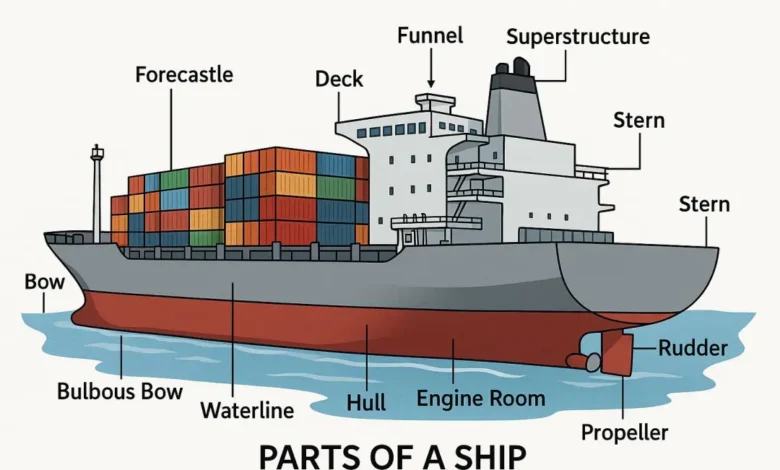
The bow, or front of the ship, is particularly important in controlling water flow. Modern ship designs often use streamlined bows that reduce wave formation and improve fuel efficiency. The stern, located at the rear of the vessel, is also designed to optimize water flow around the propeller and reduce turbulence.
Hull shape also influences how the ship behaves in waves. A well-designed hull allows the vessel to move comfortably through rough seas while maintaining stability and minimizing structural stress.
Different types of ships use different hull forms depending on their intended purpose. Cargo ships often prioritize cargo capacity and fuel efficiency, while high-speed vessels focus more on hydrodynamic performance and reduced resistance.
Buoyancy and Displacement: Why Ships Float
One of the most fundamental principles of ship design is buoyancy. A ship floats because the water it displaces creates an upward force that balances the weight of the vessel.
This principle is rooted in the concept that when an object is placed in water, it pushes aside a volume of water equal to the submerged portion of the object. The weight of this displaced water creates the buoyant force that supports the vessel.
Naval architects must carefully calculate displacement during the design process. Displacement refers to the total weight of the water displaced by the ship, which corresponds to the weight of the vessel itself when it is floating.
These calculations help determine how deeply the ship will sit in the water, a measurement known as draft. Maintaining the correct draft is essential for safe operation because it affects stability, maneuverability, and the vessel’s ability to navigate shallow waters.
Accurate buoyancy calculations ensure that the ship remains afloat under different loading conditions, including variations in cargo weight, fuel levels, and passenger capacity.
Stability: Keeping Ships Upright in the Ocean
Stability is one of the most critical aspects of ship design. A stable vessel must remain upright and return to equilibrium after being disturbed by waves, wind, or uneven cargo distribution.
When a ship tilts to one side, the shape of the submerged hull changes, altering the distribution of buoyant forces. Naval architects analyze these changes to determine whether the ship will return to its upright position or continue to tilt further.
The relationship between the ship’s center of gravity and the center of buoyancy plays a key role in stability calculations. If the center of gravity is too high, the ship may become unstable and more prone to rolling.
To ensure proper stability, naval architects perform detailed calculations that evaluate how the vessel responds to different angles of tilt. These calculations are often supported by computer simulations that model real-world sea conditions.
Designers must also consider dynamic stability, which refers to the ship’s ability to recover from large waves or sudden shifts in cargo weight.
Structural Strength and Load Distribution
Ship design also requires careful attention to structural integrity. Vessels must withstand a wide range of forces during their operational life, including wave impacts, cargo loads, and stresses caused by bending along the length of the hull.
As a ship moves through waves, different sections of the hull experience varying levels of stress. Naval architects analyze these forces to ensure the structure can resist bending, twisting, and fatigue over time.
Modern ships rely on strong internal frameworks composed of bulkheads, frames, and stiffeners that reinforce the hull. These structural elements distribute loads across the vessel and help maintain overall strength.
Materials used in ship construction also play an important role. Steel remains the most common material for large vessels due to its strength and durability, while aluminum and composite materials are often used in smaller or high-speed vessels.
Careful structural design ensures that ships can operate safely even in challenging sea conditions.
Hydrodynamics and Resistance Analysis
Hydrodynamics is a core discipline within ship design that focuses on how water flows around the vessel. Understanding these flow patterns allows naval architects to reduce resistance and improve overall performance.
As a ship moves through water, it encounters several types of resistance, including frictional resistance from water moving along the hull surface and wave resistance created by the waves generated by the vessel.
Reducing resistance is critical for improving fuel efficiency and lowering operating costs. Even small improvements in hull design can lead to significant savings over the lifetime of a vessel.
Modern naval architects often use advanced computer simulations and scale model testing to study hydrodynamic performance. These tools help designers refine hull shapes and identify opportunities to improve efficiency before the ship is built.
Read Also: How Emerging Technologies Are Transforming Governance, Risk & Compliance
Stability Calculations in Practical Ship Design
Stability calculations are a routine part of naval architecture and are used throughout the design process. These calculations determine how a vessel behaves under different loading conditions and sea states.
Engineers evaluate multiple stability scenarios, including fully loaded conditions, partially loaded cargo states, and emergency situations where compartments may become flooded.
By analyzing these scenarios, designers can ensure the ship meets safety standards and remains stable under realistic operating conditions.
Stability calculations also influence decisions related to ballast systems. Ballast tanks allow ships to adjust their weight distribution by taking in or releasing seawater, helping maintain balance during cargo operations.
These calculations are essential not only during the design phase but also during daily ship operations.
The Importance of Computer Modeling in Modern Ship Design
Modern ship design increasingly relies on advanced computer modeling to simulate vessel performance before construction begins. Digital tools allow engineers to test hydrodynamic behavior, stability characteristics, and structural loads in virtual environments.
These simulations help designers identify potential issues early in the design process and make adjustments before costly manufacturing begins.
Computational fluid dynamics models allow naval architects to visualize how water flows around the hull and identify areas where resistance can be reduced.
Structural modeling software also helps engineers analyze stress distribution across the ship’s framework, ensuring the vessel can withstand operational loads.
While traditional calculations remain important, digital tools have significantly improved the accuracy and efficiency of ship design processes.
Frequently Asked Questions About Ship Design
What is ship design?
Ship design is the engineering process of creating vessels that can safely operate in water. It involves developing the hull shape, calculating buoyancy and stability, designing structural components, and optimizing hydrodynamic performance.
What does a naval architect do?
A naval architect designs ships and other marine vessels. Their work includes analyzing hull performance, calculating stability, ensuring structural integrity, and optimizing vessel efficiency.
Why is hull shape important in ship design?
Hull shape affects how the ship moves through water. A well-designed hull reduces resistance, improves fuel efficiency, and helps the vessel maintain stability in waves.
What is ship stability?
Ship stability refers to the vessel’s ability to remain upright and return to its original position after being tilted by waves, wind, or uneven weight distribution.
How do naval architects calculate stability?
Naval architects analyze the relationship between the center of gravity and the center of buoyancy. They perform mathematical calculations and simulations to determine how the ship behaves at different angles of tilt.
What materials are commonly used in ship construction?
Most large ships are built using steel because of its strength and durability. Smaller vessels may use aluminum or composite materials to reduce weight and improve speed.
Conclusion: The Science Behind Safe and Efficient Ship Design
Ship design is a sophisticated field that combines physics, engineering, and practical experience to create vessels capable of navigating the world’s oceans safely and efficiently. From the shape of the hull to the complex calculations that determine stability, every element of a ship must be carefully engineered to perform under demanding conditions.
Naval architects rely on principles of buoyancy, hydrodynamics, and structural mechanics to ensure ships remain stable, durable, and efficient throughout their operational life. Detailed stability calculations help prevent dangerous situations, while optimized hull designs improve fuel efficiency and performance.
Advances in computer modeling and simulation have further enhanced the ship design process, allowing engineers to refine their ideas before construction begins. These tools help designers anticipate challenges and develop vessels that meet modern safety and performance standards.
Understanding the fundamentals of ship design reveals the intricate balance of science and engineering behind every vessel that sails across the ocean. By applying these principles carefully, naval architects continue to design ships that support global trade, transportation, and exploration while maintaining the highest standards of safety and reliability.